


CLOMA Official Publications
CLOMA VISION

We are committed to contributing to both Japan and the global community by pursuing innovative societal systems beyond the existing framework. As we aim to create new markets and bring to life the future envisioned by CLOMA, we have revised the CLOMA Vision to clarify our goals for this transformation.
Action Plan

We have formulated this action plan to implement specific initiatives related to the 5 Key actions defined in the CLOMA Vision.
News & Announcements
-
2026-04-03
info
4evergreen Forum: “Guidance on the Improved Collection and Sorting of Paper-Based Packaging for Recycling” -
2026-04-03
info
4evergreen Forum “Circularity by Design Guideline for Paper-Based Packaging” -
2024-06-11
info
2 Booklets prepared by JAIF (Japan ASEAN Integration Fund Japan-ASEAN Integration Fund) Project are now available. -
2023-12-27
info
We have posted the latest information on the progress of marine plastic waste countermeasures through public-private collaboration. -
2023-04-10
info
CLOMA has been officially accredited as an observer to the governing body of the United Nations Environment Program (UNEP).
About CLOMA

Sharing the Japan Model
for Plastic Resource Circulation
with the World
Solving marine plastic pollution requires not only addressing plastics that have already accumulated, but also building systems across society—beyond national and regional boundaries—to prevent further leakage into the environment.
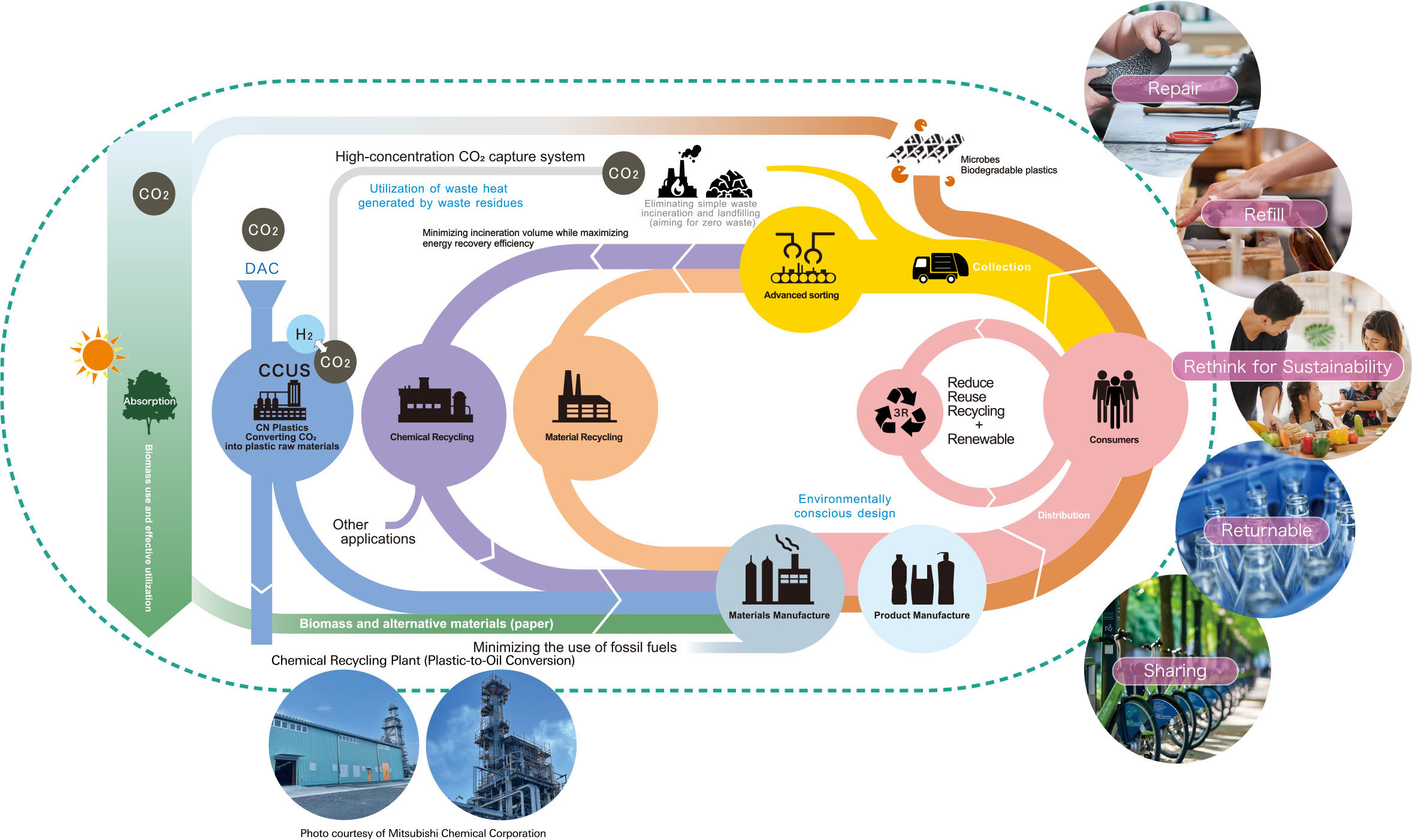
Guided by a shared vision, CLOMA brings together the technologies and expertise cultivated by Japanese industry. Through public–private collaboration, CLOMA promotes the circular use of plastics, centered on the 3Rs (Reduce, Reuse, Recycle) and alternative materials.
By engaging consumers and society, CLOMA promotes the Japan Model on the global stage—positioning it as a Japan-originated solution for realizing a circular society and eliminating plastic waste leakage into the oceans.
A Carbon-Neutral,
Nature-Positive Future
As part of its activities, CLOMA promotes a circular economy through the Japan Model of plastic resource circulation. CLOMA extends its focus beyond industry to consumer lifestyles, supporting the transition to a more sustainable and resource-efficient society.
By reducing use of fossil resources and accelerating the shift to non-fossil alternatives— such as biomass—for raw materials and fuels, we can contribute to carbon neutrality while preventing the loss of biodiversity.
It also works to prevent the leakage of plastic waste into the environment, striving to achieve clean oceans and a nature-positive future.
Creating New Innovation
Through Corporate Collaboration
CLOMA is an alliance that brings together a diverse range of stakeholders, including companies, partner organizations, local governments, relevant ministries, and observers. Organizations from different industries and with distinct roles unite to address a shared societal challenge.
Taking a comprehensive view of the entire plastic lifecycle—from materials and manufacturing to distribution, collection, and recycling—participants contribute their respective expertise and strengths to drive practical collaboration that transcends organizational boundaries.
Through these collaborations, CLOMA fosters innovation that goes beyond technological development to achieve real-world implementation, including new systems and frameworks that no single organization could create alone.
-
Total 441 companies and groups
( Executive Members 33 Members 408 )
- Local
Government
Members 18 - Observers 12
- Government
Ministries
and Agencies 3 - Partner
Organizations 4
As of September 21, 2026
Steering Committee Members: 33 Companies and Organizations (in alphabetical order)As of September 21, 2026

Unauthorized reproduction or use of the logos displayed is prohibited.