- HOME
- About CLOMA
- Creating Synergy Through Collaboration
About CLOMA
Creating Synergy Through Collaboration
Innovation Through Corporate Collaboration
Building a Japanese-style circular economy society requires more than any single company or industry can achieve on its own. From material development and manufacturing to logistics, distribution, collection, recycling, and communication with consumers, resource circulation becomes part of society only when a wide range of stakeholders work together and play their part.
CLOMA brings together companies, local governments, observers, government ministries, and partner organizations to help build a Japanese-style circular economy society. Through collaboration at every stage, from technology development to real-world implementation, CLOMA is working to turn this vision into reality.
Turning Vision into Reality
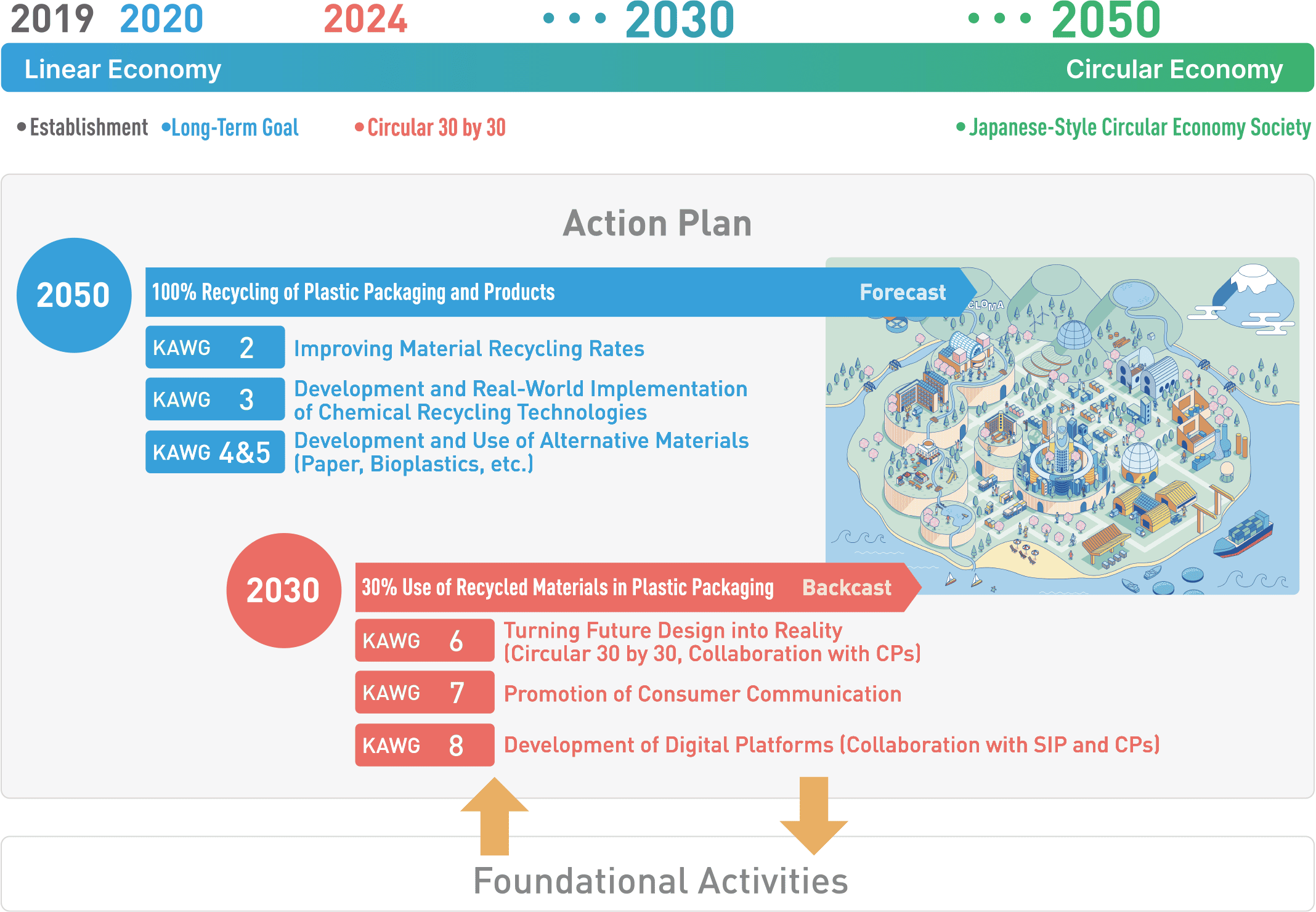
Key Actions Toward 2050
To achieve its 2050 goal of 100% recycling of plastic packaging and products, CLOMA has identified a set of Key Actions that guide its activities.
In its early years, CLOMA focused primarily on developing recycling technologies and alternative materials. However, technology alone is not enough to make resource circulation a natural part of society. Today, CLOMA is also working to accelerate real-world implementation through initiatives such as designing future social systems, engaging with consumers, and developing digital transformation (DX) platforms.
Each Key Action is led by a Key Action Working Group (KAWG), where companies and organizations from a wide range of sectors work together to test ideas, refine solutions, and turn them into practice. Through these collaborative efforts, CLOMA is helping to build a Japanese-style circular economy society.
Collaboration Platform
Core Committees
As a collaboration platform supporting its Key Actions, CLOMA has established three Core Committees: the Promotion & Outreach Committee, the Technology Committee, and the International Collaboration Committee.
Through activities such as technical exchange, business matching, information sharing, and international cooperation, these committees help strengthen connections among members while expanding the reach of new technologies and expertise.
The relationships built through these ongoing activities create opportunities for new partnerships and help drive innovation in the systems that support a circular economy.

CLOMA’s Approach to Putting Resource Circulation into Practice
To help its members work toward a common goal, CLOMA has established a shared approach to creating solutions to social challenges and advancing its activities. The sections below outline CLOMA’s vision, guiding principles, and key areas of activity.
[CLOMA’s Response to Social Challenges]
CLOMA is working to create solutions to the environmental challenges associated with plastics and build a sound material-cycle society.
By promoting a sustainable 3R system and making the most of material technologies, CLOMA aims to create clean oceans while contributing to the Sustainable Development Goals (SDGs). All of these efforts are guided by a shared set of principles.


[CLOMA’s Mission and Ideals]
-
Mission
Contribute to creating a Japan-type circular economy society free from ocean plastic pollution.
-
Action Guideline
Promote collaboration among companies in the value chain, the central and local governments, academia, consumers, and other stakeholders to achieve a clean ocean.
-
Functional Role
Support the achievement of a circular economy through business activities, contributing to carbon neutrality and a nature-positive world.
[CLOMA Principles]
-
1
We will contribute to achieving the SDGs and cleaner oceans throughout the entire material and product lifecycle.
-
2
We will focus on two key goals: thoroughly implementing proper collection, disposal, and resource circulation of used plastic products, while accelerating efforts on the 3Rs and adopting environmentally sound alternatives, such as biomass and other sustainable non-fossil resources.
-
3
We will actively share technology, knowledge, and experience among our members to foster large-scale innovations, including new business models.
-
4
We will optimize the combination of technology development and social systems, gain the understanding and support of stakeholders, and propose policies to accelerate social implementation.
-
5
We will promote our “Japan Model” globally, adapting it to each country’s unique conditions to enable circular resource use and reduce environmental impacts.
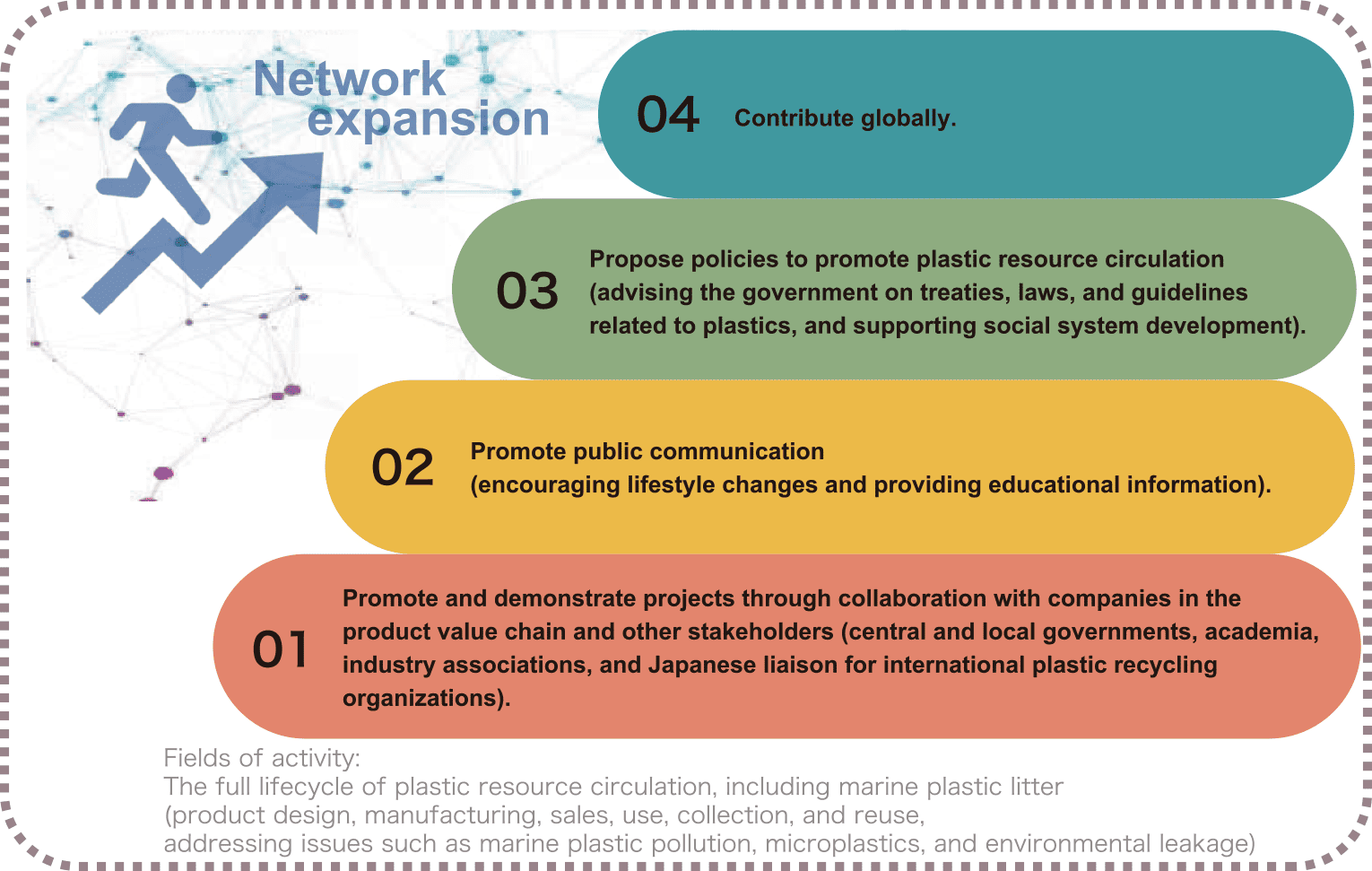
[Facilitation Modes and Fields of CLOMA Activities]
CLOMA’s fields of activity span the entire lifecycle of plastic resource circulation, addressing a wide range of environmental challenges associated with plastics. Its activities go beyond technology demonstration to encompass multiple aspects necessary for putting ideas into practice in society, including institutional development, communication with consumers, and international cooperation. A defining feature of CLOMA is its commitment to expanding engagement with society through concrete projects, policy proposals, and information dissemination.
Collaboration Outcomes
Driving Innovation
Through its Key Actions and Core Committee activities, CLOMA is creating new opportunities for collaboration, not only among companies, but also with local governments, government ministries, and a wide range of organizations. These collaborations span the entire supply chain, from materials development and product commercialization to collection, recycling, and putting solutions into practice. New opportunities for co-creation are also emerging through business matching.
Even challenges that are difficult to solve alone can lead to new value and innovation when organizations bring together their expertise, technologies, and experience.
The Collaboration Case Studies section highlights projects born from collaboration among CLOMA members, as well as initiatives that help turn ideas into real-world solutions.
-

Collaboration Case Studies
Approximately 50% reduction in plastic use through environmentally friendly packaging
TOPPAN received the Minister of Economy, Trade and Industry ...
-

Collaboration Case Studies
Use of recycled material from collected used clear plastic folders in product containers
S.T. Corporation renewed its “Shoshuriki for Trash Cans” ser...
-

Collaboration Case Studies
Limited-edition Eco Tray® products highlighting recycling initiatives
FPCO, in collaboration with AEON, is promoting the realizati...